Nov 1, 2026
Serhii Zhadan in Denmark: A strong Ukrainian Voice in the Nordic Conversation

A few days of Serhii Zhadan’s visit to Copenhagen passed in a whirlwind of meetings, interviews, public appearances, literary conversations and encounters with Danish readers. From Bogforum 2026 to events in Ukraine House in Denmark, hundreds of people gathered to hear one of Ukraine’s most prominent contemporary writers, musicians and cultural voices speak about the reality of war, the resilience of Ukrainian society and the vital role of culture in the struggle for Ukraine’s future.
Throughout his visit, one message remained clear: Ukraine needs continued military support, and its largest army needs weapons. At the same time, Zhadan spoke about the importance of building a strong, cohesive society in which no one affected by the war is left behind.
This vision is reflected in the work of the Khartiia Corps, which is developing a new approach to the military – one that understands the army as a community with responsibility not only for its defenders but also for their families, children and the wider society.
Culture that survives underground
One of the most moving themes of Zhadan’s conversations was the reality of life in Kharkiv, where culture has been forced underground – into bunkers, basements and improvised spaces. Yet it remains alive, active and essential to the community.
In his interviews and public appearances, Zhadan repeatedly described how Ukrainian society is experiencing the war: a society under enormous pressure, exhausted and constantly on edge, yet determined to remain together.
"Ukrainian society is a society without skin: extremely tense, tired and nervous. Of course, a writer has to remember this; a writer has to be able to feel it. The events we are experiencing, the people we meet and communicate with – all of this encourages us to act, to write, not to give up."
For Zhadan, culture is not a luxury that can be postponed until after the war. It is part of how Ukrainians endure, understand their experiences and preserve their identity. Even under the most difficult circumstances, literature, music and cultural initiatives continue to create spaces for connection, solidarity and resistance.
He also reflected on how the war has transformed the Ukrainian language and the possibilities of literature itself:
"The war breaks the language. Already in 2014, when Russia began the war, the language changed. And with the full-scale invasion, it broke. This can be compared to a broken hand. I clearly remember the first weeks of the war, when it was impossible to describe what we felt. We are only now learning to talk about these experiences."
The experience of living through a war cannot be compared to reading about one. The reality of hearing aircraft overhead and witnessing the destruction they bring is fundamentally different from anything previously imagined through literature. As a result, a new Ukrainian literature is emerging – one capable of absorbing, expressing and documenting an unprecedented contemporary experience.
Ukraine's future cannot be separated from its territorial integrity
During his interview with Weekendavisen, Zhadan addressed the importance of Ukrainian artists and cultural figures remaining visible on the international stage. Their presence matters not only because they bring Ukrainian culture to international audiences, but also because they challenge misleading narratives about the war and Ukraine's future.
Increasingly, discussions about peace are accompanied by questions that echo Russian narratives: What if Ukraine gives up Donbas? What if its strength runs out? Will the country continue fighting if European support weakens?
Responding to suggestions that territorial concessions could bring peace, Zhadan urged audiences to pay close attention to Vladimir Putin's own rhetoric.
"I would advise people to listen to the rhetoric used by Putin over the past three to four years. It clearly states that he is interested not only in Sloviansk and Kramatorsk."
He emphasised that Russia's ambitions extend far beyond the territories it has so far failed to occupy.
"For Putin, it is about bringing the Ukrainian state to collapse and dismantling Ukraine as a geopolitical and social project. When Putin talks about Donetsk, it is worth remembering that he also regularly mentions Zaporizhzhia, Kherson, Kharkiv and other Ukrainian regions. Therefore, I consider the statement that, to end the war, Russia only needs what it failed to capture in 13 years of war to be a deceptively Russian manipulation."
At a time when the meaning of peace is increasingly being distorted and capitulation is sometimes presented as a realistic alternative, Zhadan's presence in Denmark offered an important reminder: a just and lasting peace cannot be built on the destruction of Ukrainian sovereignty.
His visit also highlighted the importance of Nordic solidarity with Ukraine, particularly as discussions about the war become increasingly influenced by fatigue, fear and political short-sightedness.
Keeping Ukraine's voice present
For Ukraine House in Denmark, bringing Ukrainian perspectives into Danish and Nordic conversations is central to its mission. Ukrainian voices must be heard directly – not spoken about without Ukrainians, and not filtered through narratives that misrepresent the country's reality.
Zhadan's visit created opportunities for precisely this kind of exchange. Through interviews, public discussions, literary events and informal encounters, Danish audiences had the opportunity to hear about Ukraine from someone who lives and works at the intersection of culture, society and war.
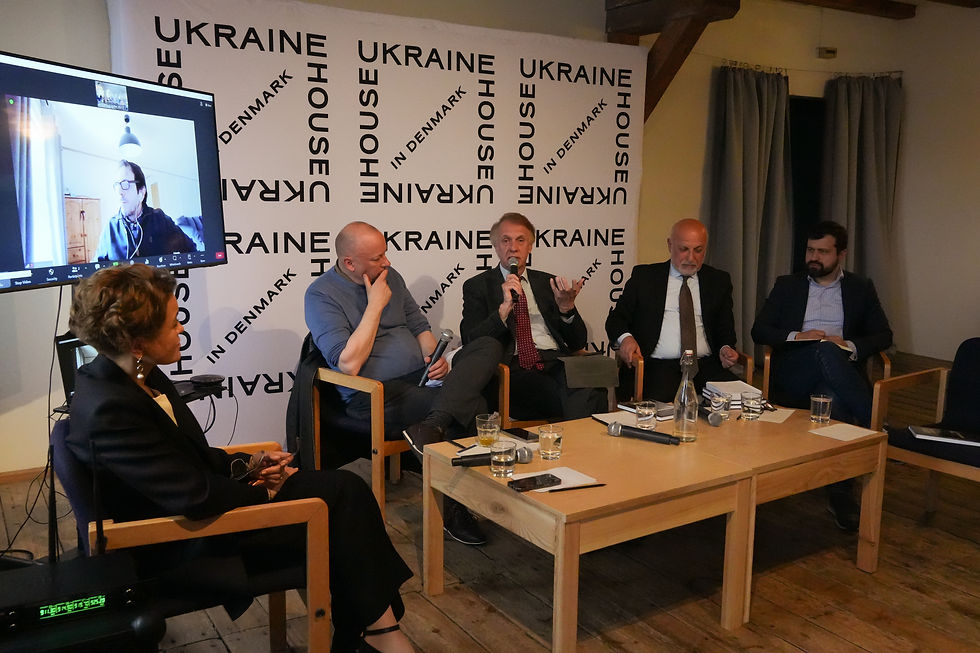
At Bogforum 2026, Ukraine House presented not only its stand but also the pop-up exhibition Voices of Dignity, bringing Ukrainian stories and perspectives to a large audience. The programme also included the joint event Kharkiv–Copenhagen: A Conversation with Ukrainian Writer Serhii Zhadan, organised in cooperation with the Danish Cultural Institute.
The conversations continued at Ukraine House in Denmark, where readers and guests gathered to listen, exchange thoughts and meet the writer. Long queues for book signings, thoughtful questions and packed events demonstrated the strong interest in Ukrainian literature and the realities behind it.
At every encounter, Zhadan brought the same combination of honesty, clarity and determination: an insistence on speaking about Ukraine as it is – complex, exhausted, courageous and unwilling to surrender its future.
At the closing of one of the conversations, he offered a simple but powerful reminder:
"Wherever we are – in Kharkiv or here in Copenhagen – remember that we are Ukrainians, and no one will be able to take that away from us."


Discover our programs
- Page 1
Show more

Voices of Dignity

Decolonizing Mindsets for Security in Europe Forum
Stay in the know
Subscribe to receive updates on upcoming events, talks, and initiatives. Stay connected with our latest announcements and opportunities.